STORIES
Okuri-inu and the Wolf: Fearing and Honoring What Follows You in the Mountains
There's something curious about okuri-inu stories. The "sending-off dog" follows you from behind along a mountain path at night, and if you fall, it pounces. And yet it's also someone you thank once you're safely home. Why would you thank something so frightening? Look for the answer, and you'll find the wisdom of people who lived in the mountains, and the shape of the wolves that once lived there too.
The rule: don't fall
The most important thing in any okuri-inu story is the rule that if you fall, it attacks. Turn that around, and it means nothing happens as long as you keep walking without falling.
Falling on a dark mountain path was dangerous all on its own. Twist an ankle, and you might not be able to walk, left alone in the mountains at night. So the okuri-inu tale can also be read as a lesson: on a night path, watch your feet and don't panic.
People also say that even if you do fall, you'll be safe if you sigh "dokkoisho" (the little grunt people make as they sit down) and act as if you only stopped for a rest. Even if you stumble, stay calm and don't show weakness. Tucked inside a scary story, there seems to be a quiet tip for getting through the mountains safely.
It sees you home, it keeps you safe
Look at the name, too. "Okuru" means to see someone off, or to walk them all the way to where they're going. People didn't call it the dog that chases you, but the dog that sees you home, and that says something about how they saw it.
In some places, people say the okuri-inu followed travelers to protect them from other animals. That's why you thank it at your door and send it on its way. Fear and gratitude living side by side in a single creature: that's what makes the okuri-inu special.
The wolf as a messenger of the mountain gods
In some regions, the okuri-inu is also called okuri-okami, the "sending-off wolf." Its image is thought to carry people's feelings about the Japanese wolf that once lived in the country's mountains.
Wolves were frightening animals, but they also drove away the deer and wild boar that ruined farmers' fields. Because of this, beliefs grew up in many places that honored the wolf as a messenger of the mountain gods, or even as a god itself. Some shrines enshrine the wolf under the name Oguchi-no-Magami, the "great-mouthed true god," and offer paper charms meant to keep away crop-raiding animals, fire, and thieves. There's even a theory linking "okami," the word for wolf, to "o-kami," meaning "great god."
The Japanese wolf hasn't been confirmed alive since the Meiji era (1868-1912), and it's now thought to be extinct. Even after the wolves vanished from the mountains, the okuri-inu stories went on being told.
Dogs of a different kind
Japan has other yokai told of as dog-like. The sunekosuri of Okayama Prefecture, for example, is a friendly little yokai that just rubs past your legs on rainy nights. Next to it, the okuri-inu still carries much more of the tension of a wild mountain animal.
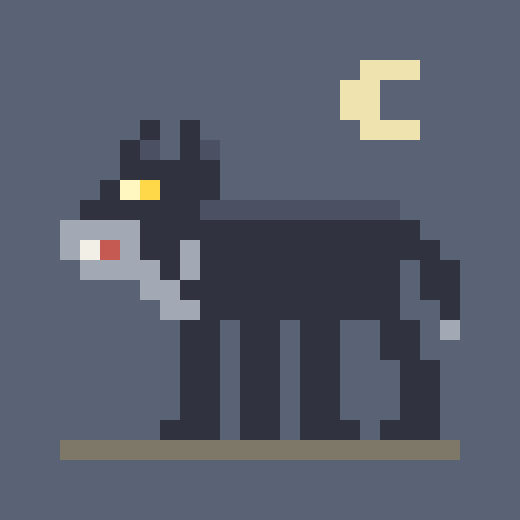
On Pixel Yokai's okuri-inu page, we drew it as a wolf-like figure with glowing eyes, standing on a dark mountain path. If you ever sense something behind you on a night road, don't fall, and stay calm. And when you get home, say a quiet "thank you."